After Issuance
After Issuance: What CLARITY Doesn't Touch
September 2, 2026

Real-world assets are one of the loudest catalysts in crypto this year. However, with thin secondary volume, little collateral use, few venues that will touch it, the bet across the industry is that regulation is what opens the floodgates, and in the US that bet has a name: the CLARITY Act.
US securities rules set the effective floor for (global) institutional tokenized securities, because of dollar liquidity and it’s where the largest buyers are, too. An issuer that clears its home regime and also meets US requirements gets the largest markets. That's why the US definition sets the bar the rest of the market builds toward.
So CLARITY matters. For tokenized securities, though, it does not touch the thing keeping them idle.
The Line CLARITY Draws
The bill gives the CFTC exclusive authority over spot markets in digital commodities and leaves the SEC with investment-contract assets. The distinction is, thankfully, simpler than it sounds. A digital commodity is a token whose value comes from its own network, like ETH, where no one fundamentally owns, issues, or is beholden to anything. An RWA is the opposite: a claim on an issuer who does [1].
That places RWAs squarely on the SEC's side of the line, where they already were. Tokens representing equity, debt or similar rights stay under SEC jurisdiction, and tokenization is treated as a delivery method, not a new asset class. Registration, reporting and transfer restrictions carry over untouched [2].
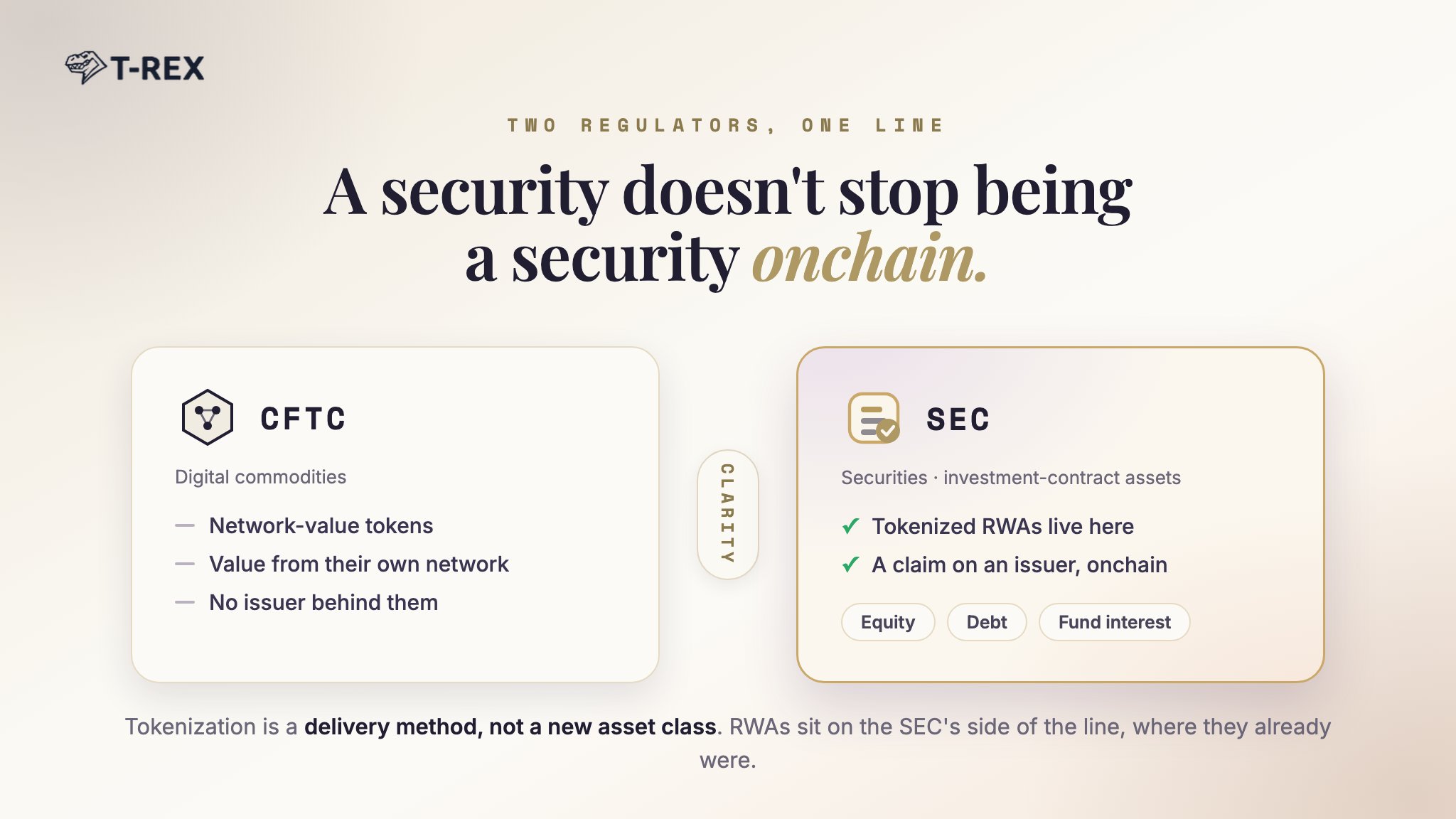
So, this means a security does not stop being a security because it moves onchain, but the problem for RWAs sits downstream: it’s in what you (as an issuer) have to prove to make the token usable.
This is what regulatory agencies are supposed to do: draw clear lines in clear terms.
It also acknowledges what the former administration refused to recognize - that most crypto assets are not themselves securities.
Paul Atkins, SEC Chair
The Bar That Actually Lands on RWAs
To represent a token as the security itself, an issuer would have to prove equivalence: equivalent legal rights, verified ownership, and an auditable, resilient record.
A token that cannot prove it is the security cannot sit with a qualified custodian, cannot list on a compliant venue, and cannot be posted as collateral. It stays a certificate that does nothing, which is most of what tokenized RWAs are today.
Today, proving equivalence is ultimately good practice. A case-by-case attempt for compliance under guidance, not legislation. Under the bill, it becomes the conditions for compliant tokenizing at all.
The rest of what CLARITY changes lands one layer out, on the market the asset moves through.
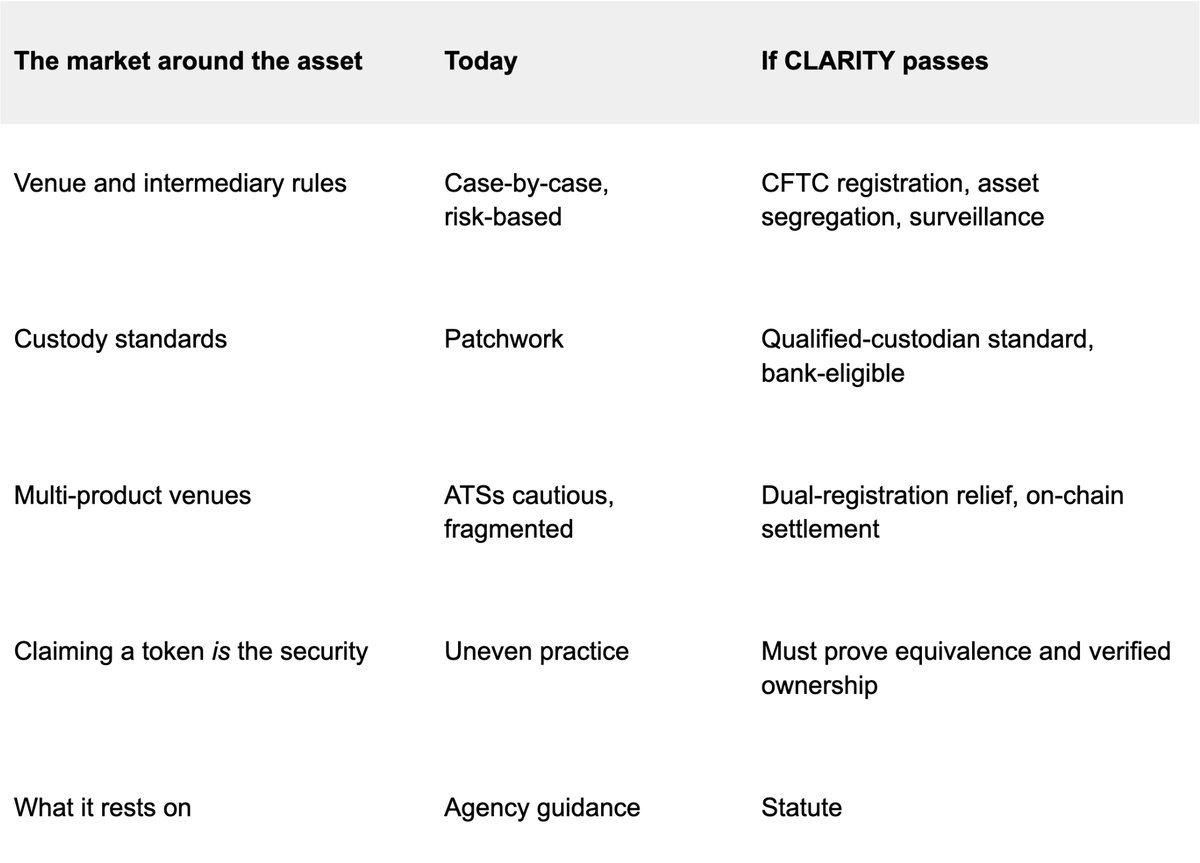
For venues, a statutory framework replaces risk-based judgment on listing, custody and market-making, with mandatory registration, customer-asset protection and surveillance [3]. Custody gets qualified-custodian standards covering key control, insurance and proof-of-reserves, and a trading platform that can hold parallel digital-commodity registration to cut duplicative compliance [4].
So ultimately, the assets themselves remain unchanged. It’s the legal rails that get sharper, and the bar for calling a token equivalent to the security behind it goes up.
Build for the Rules as They Are
CLARITY has traveled further than any market-structure bill before it. The House passed it in July 2025 by a wide margin, the Senate Banking Committee advanced it in May 2026, and is now sitting idly on the Senate calendar, eligible, yet unscheduled for a floor vote (and at the time of this writing, low Polymarket odds for passing in 2026).
Some version of it probably becomes law eventually. The timing is the part no one can trade on, which is exactly why you don't build to the vote.
The rules governing RWAs right now are administrative: the SEC and CFTC's March 2026 joint guidance, which sorts digital assets into a five-category taxonomy, can be rescinded by a future administration without a vote (as is guidance). Further, more SEC rulemaking is expected in the second half of this year. Thus, the demand to prove equivalence, verified ownership and an auditable record shows up under today's guidance and presumably again under tomorrow's statute.
So the planning problem is not which way a vote goes. It is how to build to a bar that holds while the rules around it (might) move.
As powerful as blockchain technology is, it does not have magical abilities to transform the nature of the underlying asset… market participants must consider - and adhere to - the federal securities laws when transacting in these instruments.
Hester Peirce, SEC Commissioner (Crypto Task Force lead)
Building Around the Legislation That Defines Adoption
Regardless of what comes next, there’s a common theme that regulators have made clear. They want round pegs in round holes, and right now the industry is ultimately attempting to self regulate by example. In order to do this, onchain activity must mirror the stringent regulatory standards and practices of custodial exchanges.
A tokenized security has to verify ownership before it changes hands. It also needs one, unified, cross-venue authoritative record of who owns what and under which conditions. It has to keep those controls intact as it moves across venues, custodians and applications.
This means identity, eligibility and compliance must operate through the asset, resolved against a unified ownership record that a licensed operator can make legally definitive. Coordination across approved environments will become the standard, rather than rebuilt in the corner of every market.
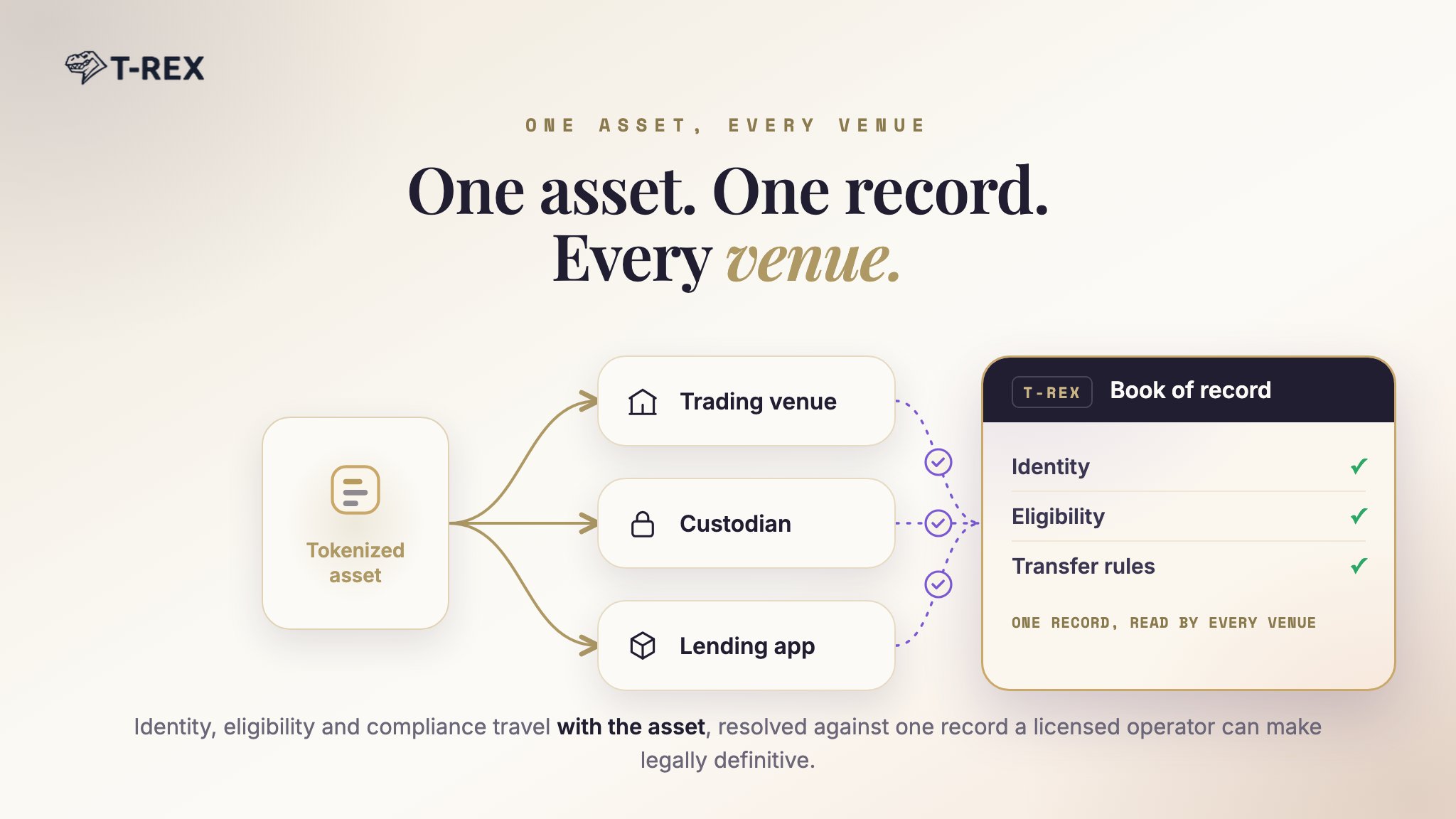
Put simply, verified ownership, records that stay correct as the asset moves, with controls that travel cleanly with it.
The bar comes either way, build to the above and the rest follows.
A token that can prove equivalence can be custodied, listed, and (what crypto is betting on) posted as collateral. Ones that can't stay an idle certificate, which is what most tokenized RWAs still are.
In short, the industry is betting CLARITY opens the floodgates. It won't. Infrastructure will.
References
- Skadden
- CBIZ
- Bitfinex
- Montague Law
Also posted on