After Issuance
After Issuance: Compliance that travels
September 16, 2026

The industry has spent three years proving that securities can be issued onchain, and it succeeded. What it has not produced is a reason for the asset to exist there. A tokenized instrument that cannot reach a custodian, a venue or a financing desk beyond the platform that issued it delivers the economics of a paper certificate with better typography.
This series began with a simple claim: a tokenized security becomes useful when it can move, settle, be serviced and support collateral. That is the part of tokenization still missing, and it shows in the numbers the industry prefers not to quote. The headline figure is total value tokenized. The figure that decides whether a market exists is how much of that value can move beyond the platform that issued it. Today, very little can. Not because chains cannot pass tokens between them, but because compliance, as the industry has built it, happens after the fact.
Compliance, after the fact
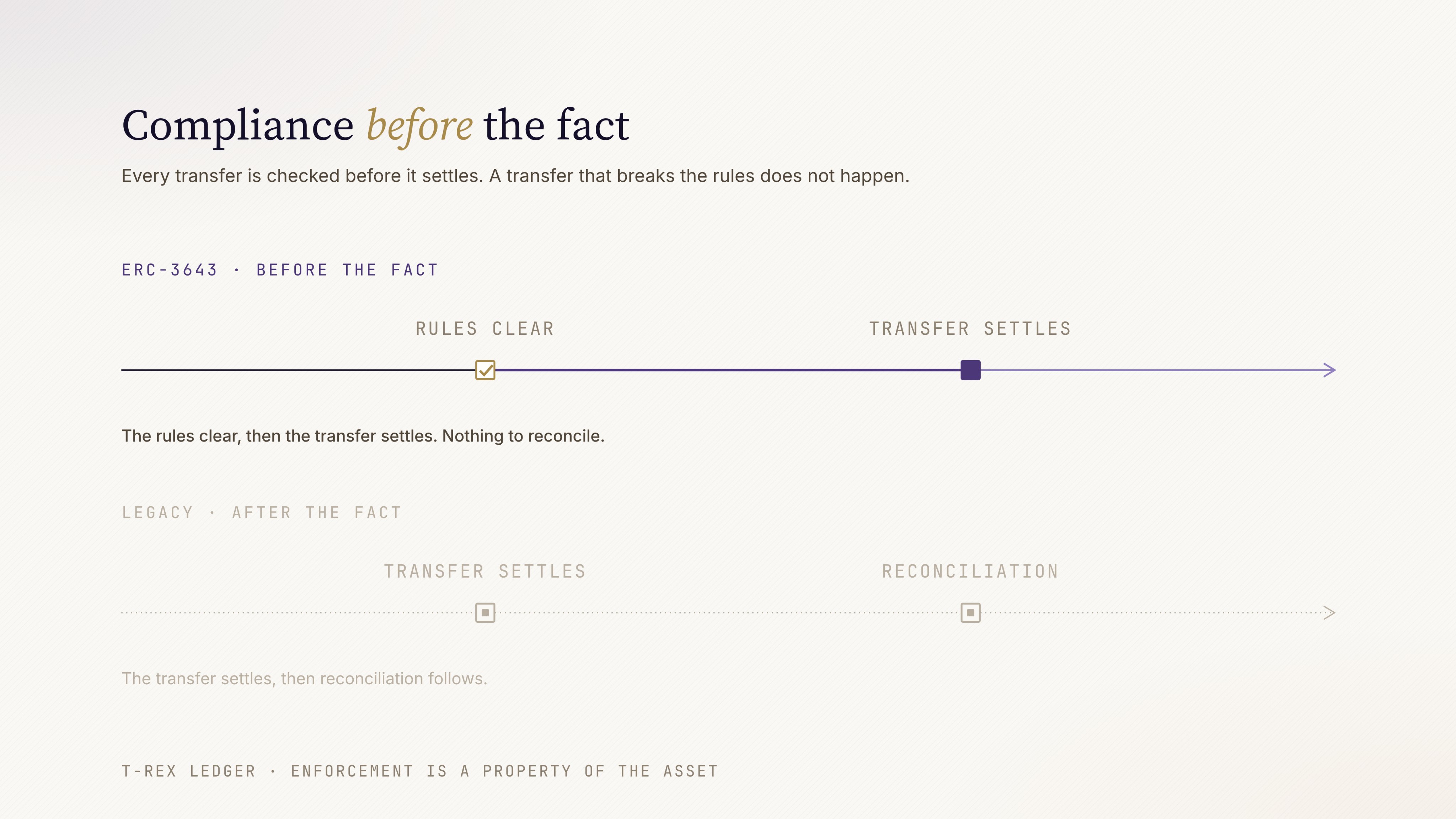
Look at how compliance actually works in today's tokenization stacks and the same pattern appears everywhere. Eligibility is enforced at onboarding, by the platform. Restrictions are enforced at the venue, by the venue. Correctness is established after settlement, by reconciling against a register kept somewhere else. The asset itself enforces nothing. The environment around it does.
After-the-fact compliance has one property that decides everything downstream: it ties the asset to the environment that performs it. An instrument whose compliance comes from its surroundings cannot leave them. Every new venue is a bilateral integration, every integration re-verifies investors already verified elsewhere, and every transfer ends in reconciliation because the truth was never in the transaction to begin with. This is why the network effect for tokenized assets has refused to fire through three years of issuance. Each platform is compliant in isolation, and isolation is the product.
Moving enforcement into the instrument
ERC-3643 inverted the model. The rules live in the asset: which credentials a holder must present, which jurisdictions may participate, what powers the issuer retains. Every transfer is checked before it settles, and a transfer that breaks the rules simply does not happen, rather than getting unwound later. Compliance before the fact.
The model had one limit. The state a transfer is checked against, identity, eligibility, the issuer's configuration, lived on the chain where the asset was issued. Within that chain, enforcement was built in. Beyond it, the industry fell back on exactly the after-the-fact machinery the standard was designed to retire. Compliance before the fact at home, and after the fact everywhere else, is not a compliance model. It is a perimeter.
Transit is a security decision
That is the context for this announcement: the T-REX Ledger is integrating Chainlink CCIP as its preferred cross-chain interoperability solution, with Chainlink's Automated Compliance Engine (ACE) extending enforcement to wherever the asset lands, and Data Streams pricing it there so it can be used, not just held
Why Chainlink specifically is worth answering properly. For a regulated instrument, transit is not a messaging problem. It is a security and enforcement problem, because the transport layer inherits the liability of what it carries: a bridge failure on a speculative token is a loss, on a fund interest it is a corrupted register. The layer under regulated value has to offer the same property the instrument itself offers, enforcement you can verify rather than operators you have to trust. CCIP's defense-in-depth design, with independent risk management checking every cross-chain action, is why it is the interoperability layer institutional finance has been willing to engage with. And a compliance-first network does not pick its transit layer case by case. It designates one and holds it to the same standard as the record. That is what preferred means.
ACE completes the picture. Identity resolves at the destination through CCID, with no re-verification and nothing disclosed. The asset's rules are enforced by the Policy Manager wherever the transaction happens. The check clears before the transfer does, on whichever chain the transfer occurs. Enforcement stops being a place and becomes a property of the asset.
Portable, not tethered
One design detail carries most of the weight. Enforcement at the destination is not a live call home on every transfer. Compliance state is validated against the canonical record, then carried across in a form that cannot be replayed, so the destination enforces on its own terms while the record keeps its authority. A live dependency would be a bottleneck presented as control. Carried authority is infrastructure. The difference is between an asset that travels and an asset on a leash.
What utility looks like
Picture the scenario this architecture exists for. A bond issued by a German institution is posted as collateral at a venue. A desk in Singapore finances the same position, then transfers it on to another qualifying entity. Every step is checked against the asset's own rules and settled on a single record, and nobody along the way gave up control to make it work. What that scenario depends on, quietly, is two things. Transit, positions crossing environments with enforcement holding at every hop. And valuation, because collateral has to be marked and a financing desk has to price what it lends against, in real time, wherever the position sits. With CCIP designated, the compliance engine enforcing at the destination, and Data Streams pricing the position on whichever chain it lands, that dependency becomes an architecture.
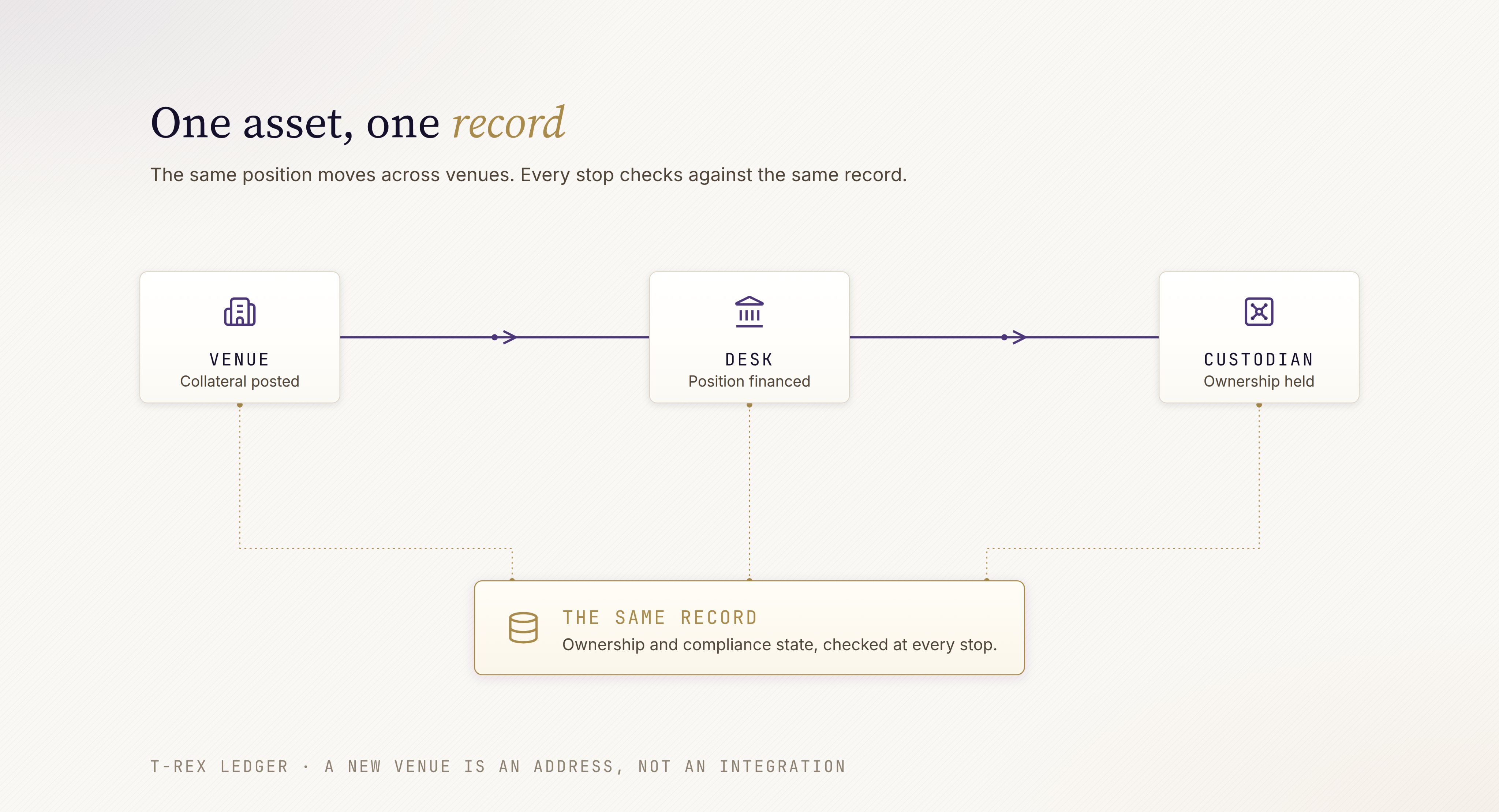
The consequence compounds. When enforcement travels, a new venue is not a bilateral integration. It is an address. Liquidity stops being a property of the issuing platform and becomes a property of the asset. And the rate at which stranded value becomes market value stops being throttled by the cost of every additional connection.
Institutions have always faced a trade-off between keeping an asset compliant and letting it move. This integration ends it: with Chainlink carrying the asset and enforcing its rules wherever it settles, compliance travels with the token rather than trapping it in one place, which is exactly what institutional tokenization has been missing.
Daniel Coheur, Co-founder, T-REX Network
The phase where they work
Issuance was the proof that securities belong onchain. Utility is the proof that they should stay. Between the two sits movement, and movement was never going to be solved by better bridges alone. It required compliance built before the fact, carried by a transit layer held to the same standard as the record.
The first phase put the assets here. This is the machinery for the phase where they work.
Also posted on